In For A Penny, In For 128 Clicks. Transgrancanaria Classic Race Report [PHOTOS]
Opublikowane w ndz., 22/03/2020 - 18:19
Nic nie jest stracone, póki wszystko nie jest skończone
[Jacek „Mezo” Mejer – Życiówka]
Pico de la Casa, 7 March, 9:45am. We yomp up the burnt out pine forest. Long sections of the race route cross the areas plagued by last year's fires on Gran Canaria. But the forest springs back to life. Burnt pines shoot new branches full of bright green needles. Canarian pine forest hangs on for grim death.
I don't realise yet that very soon I'm gonna have to be like this forest.
* * * * *
Patient zero
Las Palmas, 6 March, 11:05pm.
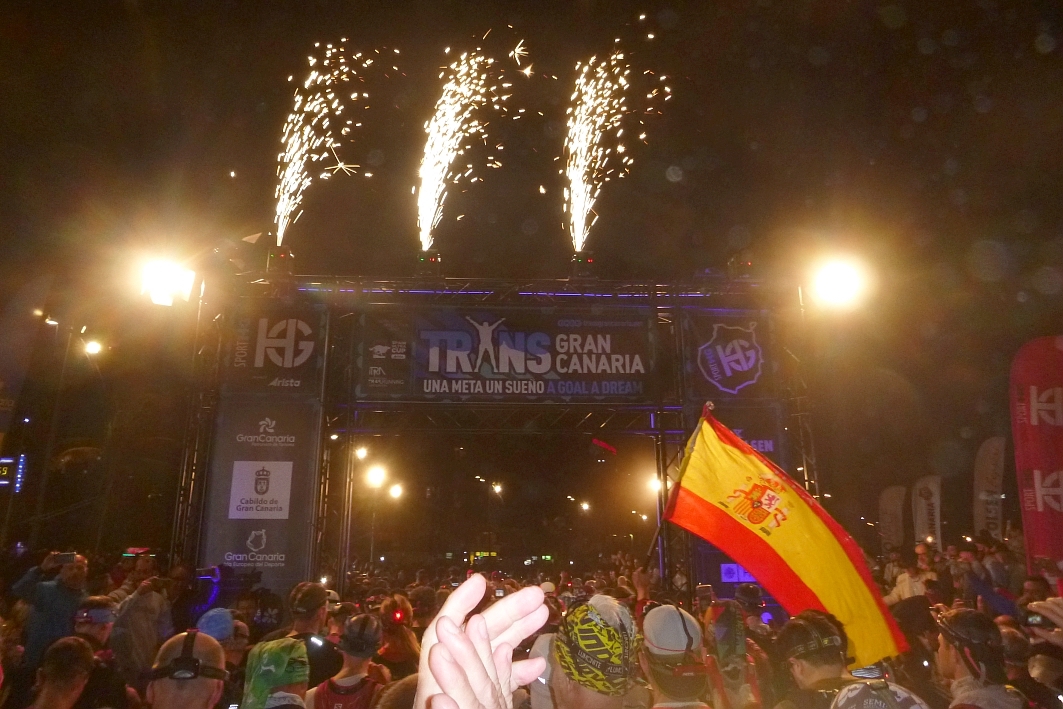
By the end of the first kilometre along the beach most of us have shoes filled with sand. Most also probably curse the the race route author's creativity. The only good point is that running on such surface makes a nice warm-up. However, the sand of Las Canteras beach will not top the chart of the most difficult surfaces we are about to run on during this race.
We enter the seaside boulevard and follow it for more than 2 km, sticking somewhere near the end of the field with Mahdi, Jacek and Daniel who I met at the start line. The former is half-Polish, half-Iraqui. The names of the remaining two can be easily remembered by every runner or drinker.
Further on, under the motorway bridge we turn to a nice dirt road with a hill. On its other side begins a long section from hell. We run through some ghost villages, ruined houses, and then a dry river bed. Dense bushes on both sides and rubble under our feet. Stones of all sizes and shapes, sliding under our shoes.The sandy beach was a wee bit more comfortable.
Magda is way ahead. It was her who shanghaied me into running this killer yomp. At the last year's Tatranská Šelma in Slovakia, when I was in much better shape, we finished together. I signed in for Transgrancanaria Classic in December, already struggling with a hamstring injury. Then came some other health and life problems, and the injury got worse. At the last moment my invaluable physio put me back on the track. In for a penny...
Anyway, over the whole February I ran less than that distance. And my January's training log clocked a mighty 25 km. I ran my last 100k in Tenerife almost two years ago, and this is supposed to be the second longest distance in my life. Am I supposed to finish it at all? Never before have I been so unprepared to any race. Physically at least. 'Cos mentally I'm always ready for a battle.
Having arrived in the island, two training runs in the mountains and a day on the beach got me an allergic reaction to sun. My forehead swollen and my right eye like after a fight with Klitschko, I look like a patient zero with some new virus strain. Anyway, let's run for survival...
Night fight
Finally we leave the bottom of this nightmare valley. A short, steep climb leads to the first checkpoint at Arucas-Santidad Alta (17 km) with the locals cheering for us, although its 1:18am. A bite and a sip and further up. Chilly, foggy, drizzly. In the dim moonlight I can see the first big hill. It turns out to be steep and muddy. Trekking poles come to help, as my shoes with "rocky" soles keep sliding. Fast downhill on the other side brings the risk of uncontrolled slide too, but here my downhill skills prove helpful.
Abdominal pain has been accompanying me for a longer while when I run into the road in the town of Teror. Those I overtook on the descent are catching up with me now. Two clicks downtown, at 28 km, awaits the checkpoint tent. I grab the munchies, sit on a chair and take turns to bend and straighten up to reduce the pain, unfortunately to no avail.
We start the next climb with another Polish runner Rafał, but then I get ahead and catch up with Ian, an Englishman living in Scotland. Together we make the whole long and tedious climb up the country roads and paths. I drop him at the steep downhill on the other side, an unpleasant one, which goes down a little concrete road. My belly gives me a hard time there again. One more bump separates me from the next checkpoint at Fontanales, 40 km down the race route.
It's still dark when I enter the checkpoint before 6:30am. Still got the safe cushion of an hour and a dozen or so minutes till cut-off. Someone tells me quite a few racers have already dropped out here. Again I try to manage the pain, unsuccessfully. I read the text from Magda. She's far ahead... and her belly hurts on the downhills too.
New day, new hope
A new day breaks when a Swedish runner who knows the route tells me what lies ahead. Then, up the hill I keep up with Jose the Canadian, while he tries to do the same with me at the descents. The sun shyly shines through clouds, and the landscape reminds me of Scotland. Good memories warm me up. Despite the wind right in my face, I briskly follow Jose up the hill.
He has worked in numerous exotic locations and taken part in many a famous race. Transgrancanaria is a part of his preparations for Badwater where he has qualified. I leave him when our route leaves the road and steeply drops down the rocky ravine of Barranco del Sao. No time for sightseeing though as we have to watch every step.
There is no trace of pain in my previously injured knee, so I can finally do my stuff. I overtake Daniel and Mahdi as well as a few other runners. It's getting warmer, so at the bottom I'm feeling pretty hot.
This crazy downhill turns into an almost equally steep climb, which catches me with a little crisis. It brings me into a local tarmac road and then to the next aid station by the dam of the artificial lake Presa de los Pérez at 51 km. Mahdi, Daniel and Jose join me in a while. We are all pretty tired and need some rest as the sun relentlessly beats down.
Be like the pines
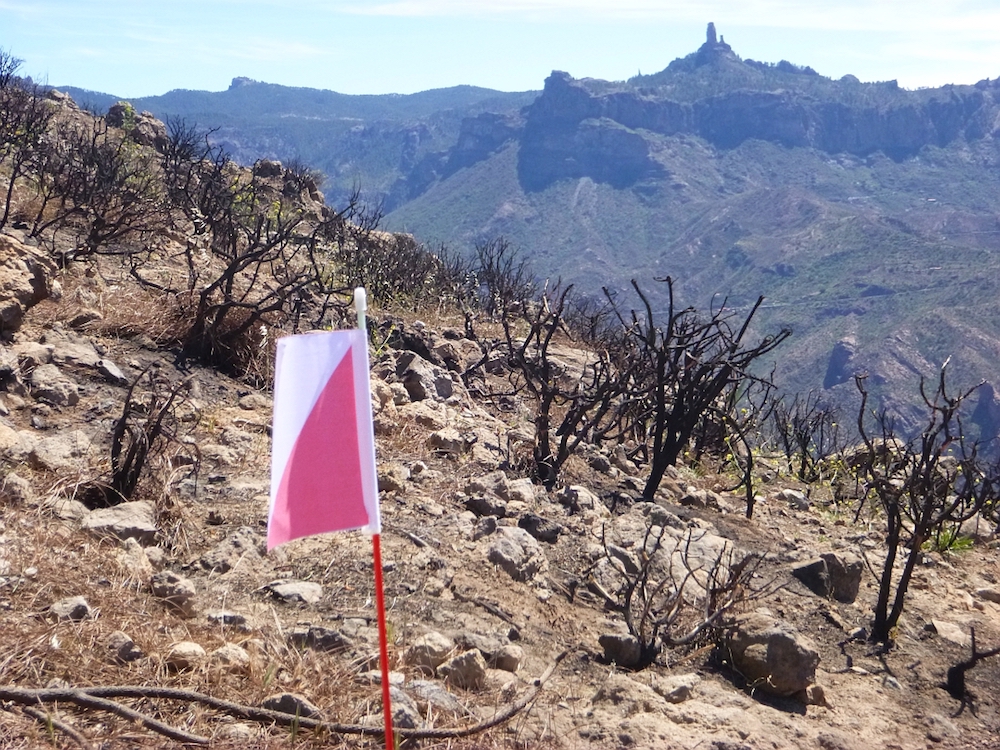
The lake remains further and further below and we yomp up the burnt out pine forest. Long sections of the route cross the areas plagued by last year's fires on Gran Canaria. But the forest springs back to life. Burnt pines shoot new branches full of bright green needles. Canary pine forest hangs on for grim death.
The club-shaped Roque Nublo is visible from far away. We'll be there in a few hours. I can also see Teide, my favourite slag heap in the neighbouring Tenerife. This westernmost part of the race route seems to go on forever and I'm beginning to feel overheated and dehydrated by the sun. Except the camelbag, I should have also filled my softflasks, although this stage is only 12 km long. At the last steep hill before Artenara I run out of water and feel really bad.
I stagger into the halfway checkpoint at 63 km like a zombie at 12:27pm, with the cut-off passing at 1:45. I'm still conscious enough to start hydrating at once. Water, Coke, Sprite, anything goes. In my blurred mind I ask myself if it still makes sense to push on. Half an hour later, feeling better, I grab two cups of bullion. Water in camelbag and one softflask, Coke in the other and I leave the checkpoint, slightly more alive. I must be like those Canarian pines.
This stage starts tediously uphill again, in the open sun, up to 1730 metres a.s.l. The descent is longer and steeper, 700 vertical metres down to Tejeda at 75 km. At the aid station again we drink a lot with other Polish runners, as another 700 vertical uphill metres await us to the most recognisable rock of Gran Canaria. It is well visible above us. (continue reading)